.svg)
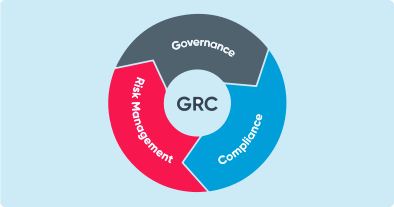
The term GRC engineering gets thrown around in conference talks and vendor marketing as if it's a single product you can install. It isn't. GRC engineering is an approach to governance, risk, and compliance that treats these functions as an engineering discipline, something you design, build, test, and operate with the same rigor you apply to your product infrastructure.
The distinction matters because most companies don't have a GRC engineering problem. They have a GRC operations problem. They bought the platform, connected the integrations, and assumed compliance would run itself. Then someone opened the dashboard six months later and found 40% of tests failing, evidence gaps across half the controls, and a security team that still can't answer a customer questionnaire without a two-week scramble.
GRC engineering is how you close that gap.
The GRC Engineering Movement
GRC engineering isn't a vendor term. It's a practitioner-led movement with a growing community and a formal manifesto. Ayoub Fandi, Staff Security Assurance Engineer at GitLab and co-author of the GRC Engineer Manifesto, has been one of the driving forces behind formalizing the discipline. His work, along with a growing community of practitioners from companies like Netflix, Zoom, and IKEA, has helped define what GRC engineering actually means in practice.
The manifesto's core values are worth knowing because they articulate what the movement is pushing away from as much as what it's pushing toward:
Measurable risk outcomes over checkbox compliance
Continuous assurance over periodic monitoring
Evidence, logic, and reason over fear and uncertainty
GRC-as-Code over tool-specific constructs
Shared-fate partnerships over transactional relationships
Automate early and often over manual processes
The Inversion Thesis
The most important idea in the manifesto is what Fandi calls the inversion thesis: traditional GRC flows top-down from framework to controls to implementation to evidence to audit. GRC engineering inverts that. It starts with actual running systems and real control behavior, letting reality define policy rather than the reverse.
This resonates with what we see across engagements. The companies with the strongest security programs didn't start with a framework checklist. They built operational security first, then mapped frameworks onto it. The manifesto gives that observation a name and a community.
What GRC Engineering Looks Like in Practice
GRC engineering is the practice of designing compliance systems that produce audit-ready evidence as a byproduct of normal operations. Instead of treating compliance as a periodic exercise where someone collects screenshots before an audit, GRC engineering embeds evidence capture, control monitoring, and risk tracking into the infrastructure, pipelines, and workflows your team already uses.
This sounds obvious in theory. In practice, it requires deliberate architecture decisions across four areas:
1. Automation Architecture
Deciding which controls can be monitored through API integrations and which require structured manual processes. The split is roughly 40-60%, not 90-10%.
2. Evidence Design
Ensuring that every control produces timestamped, verifiable evidence without someone remembering to take a screenshot. Push every control toward the highest evidence tier it can practically reach.
3. Operational Cadence
Defining what happens daily, weekly, monthly, quarterly, and annually to keep the program running. Programs run on cadence, not intention.
4. Platform Configuration
Tuning the GRC platform to match your actual environment instead of running default test libraries against infrastructure you don't have.
Each of these deserves a closer look, because the gap between *we have a GRC platform* and *we practice GRC engineering* lives in the details.
The Automation Coverage Reality
GRC platforms automate evidence collection for roughly 40 to 50 percent of controls in a standard cloud-native environment. The integrations pull configuration data, access logs, vulnerability scan results, and identity settings automatically. For companies with on-premises infrastructure, legacy systems, or less common SaaS applications, that number drops to 20-30%.
The remaining controls require structured manual effort: policy acknowledgments, risk assessment documentation, vendor reviews, training records, change management approvals, incident response evidence, and anything tied to systems without API integrations.
This isn't a platform flaw
Many controls require human judgment, documentation, and review that cannot be automated. The platform's value is in centralizing evidence and tracking deadlines, not in eliminating the work. Companies that expect 90% automation end up disillusioned and under-resourced for the manual effort.
GRC engineering starts with understanding this boundary and designing structured processes for the controls that fall on the manual side. The tool is essential, but without the right program design and ongoing operations, it's an expensive dashboard.
Evidence Design: The Tier System
Not all evidence carries equal weight with auditors. Whether the framework is SOC 2, ISO 27001, or any standard that requires demonstrated controls, there's a clear trust hierarchy:
| Tier | Evidence Type | Auditor Trust Level |
| Tier 1 | Automated system logs. SIEM events, cloud audit trails, CI/CD deployment records. Tamper-resistant, timestamped, no human intervention. | Highest. Auditor sees it and moves on. |
| Tier 2 | Screenshots and exports with dates. Access review completions, vulnerability scanner exports, patch deployment reports. | Good. Verifiable and specific, requires human capture. |
| Tier 3 | Text descriptions. Jira tickets that say *complete*, Confluence pages with no dates, spreadsheets with no system names. | Lowest. Accepted when nothing better exists. Invites follow-up questions. |
GRC engineering pushes every control toward the highest evidence tier it can practically reach. The gap between Tier 3 and Tier 2 is often thirty seconds of additional effort, yet the difference in audit outcomes is significant. The gap between Tier 2 and Tier 1 requires upfront architecture work, wiring operational workflows so that evidence is a natural byproduct of the work.
Consider how a properly structured Jira ticket for a patching cycle already contains the evidence an auditor needs: ticket created (scope defined), status changes (timestamps), comments (decisions captured), ticket closed (approval recorded). When workflows are designed with the right fields from the start, evidence collection becomes invisible because it's embedded in how the work gets done.
▶If your team is doing real security work but struggling to prove it to auditors, that's the evidence gap we help close. Book an assessment to see where your evidence tiers stand.
Platform Configuration: Reconciliation Before Remediation
One of the most common mistakes in GRC implementation is accepting the platform's default test library without reconciling it against the actual environment. GRC platforms are designed to be comprehensive, so they enable a broad set of tests during onboarding. A broad test library mapped to a generic environment does not match any specific company's setup.
The result is false failures that create unnecessary alarm and wasted effort. In one engagement, a platform had enabled 232 tests before anyone reviewed whether they matched the actual environment. A third of them were failing because they were testing for things the company didn't have: automated tests designed for Windows environments failing on Mac-only infrastructure, tests checking for integrations that hadn't been deployed, overlapping tests where one passing test made another failing test redundant.
GRC engineering requires reconciliation, but reconciliation only works if you know what you're reconciling against. That starts with a system architecture inventory: every component (servers, databases, SaaS tools, endpoints, cloud services) and every connection between them (APIs, data flows, network paths). Once the inventory exists, expected controls get layered onto each element. Components need hardening baselines, patching schedules, log generation, and access controls. Connections need encryption (TLS), authentication, and authorization checks. This map is what tells you which tests should exist in the platform, which ones are missing, and which ones don't apply.
From there, reconciliation works in three directions:
Remove what doesn't apply
Review every failing test and determine whether it applies to the actual environment. Identify where another passing test already covers the same control. Replace overly specific automated tests with manual tests that better fit the infrastructure. Disable tests that don't apply, with documentation explaining why.
Add what's missing
Default test libraries are built for generic environments. If your stack includes components the platform doesn't have out-of-the-box tests for, such as self-hosted databases, custom-built internal tools, on-premises infrastructure, or third-party integrations without API connectors, you need to create manual tests that cover those components. The platform won't flag what it doesn't know about. A company running a self-hosted PostgreSQL cluster needs configuration baseline tests for that cluster even if the GRC platform only ships with tests for managed cloud databases.
Tune what remains
The tests that do apply may need adjustment. Default thresholds, check frequencies, and evidence expectations should match how the organization actually operates, not how a generic template assumes it does.
The platform is the tool, not the program. The program involves knowing which tests matter for your environment, what's missing from the default set, and configuring the platform accordingly.
Operational Cadence: The Part Nobody Plans For
The hardest part of GRC engineering isn't the initial setup. It's what happens after. Most companies think of compliance as a series of events: the kickoff, the audit, the certificate. What they don't see until someone spells it out is the operational rhythm that sits between those milestones.
A well-run security program has distinct cadences:
Daily
Device compliance status, monitoring for disabled or stale accounts, reviewing platform alerts. Lightweight, mostly automated.
Weekly
Summarizing findings and flagging anything that needs attention. Reviewing new vulnerabilities against remediation SLAs.
Monthly
Risk register updates, new vendor assessments, changes to the environment that need to be reflected in the program. This is where the real program work happens.
Quarterly
Comprehensive access reviews that catch stale accounts and permission drift. Firewall rule reviews. Configuration drift validation.
Annually
Internal audit as a full dress rehearsal before the external auditor. Policy reviews and updates. Disaster recovery tests.
SOC 2 CC4.1 expects ongoing monitoring activities. CC3.2 expects the organization to consider changes that could significantly affect internal controls. These aren't annual events. They're continuous, and they only work when someone owns the cadence.
The question that separates GRC engineering from GRC tooling
*Who is responsible for running this program every week for the next twelve months?* If the answer is the CTO on top of their real job, the program is already fragile. Programs run on cadence, not intention.
▶Most companies don't have someone to own this cadence, and that's where programs stall. We act as a fractional security team that keeps the operational rhythm running. See if it's the right fit.
Shift-Left: Where GRC Engineering Meets Development
The shift-left approach to compliance means embedding security and compliance checks into development workflows rather than bolting them on before an audit. In GRC engineering terms, the CI/CD pipeline becomes a source of compliance evidence.
SAST and DAST scanning in the pipeline produces evidence for SOC 2 CC7.1 (vulnerability detection). Protected branches with mandatory peer review satisfy CC8.1 (change management). Infrastructure as code provides configuration management evidence that auditors trust because it's version-controlled and repeatable.
The architecture decision matters here. Teams choosing between assembling individual open-source tools, using their source control platform's built-in security features, or adopting an all-in-one security platform are making a GRC engineering decision. The auditor doesn't care which approach you use. They care that you have coverage, that it runs consistently, and that you can show the results.
When pipeline security output integrates with the GRC platform, every code change automatically generates compliance evidence. That's Tier 1 evidence produced without anyone remembering to document anything.
Why GRC Engineering Matters for Revenue
GRC engineering isn't just an operational improvement. It's a revenue function.
Companies with well-engineered GRC programs handle security questionnaires from pre-approved evidence rather than assembling answers from scratch. When 80-90% of prospect security questions are answered automatically through a trust center backed by a running program, deal velocity changes. The security review stops being a bottleneck and becomes a competitive advantage.
The teams that automate GRC thoroughly don't just pass audits faster. They free the security team to focus on the work that actually reduces risk: deeper vulnerability management, more frequent incident response testing, proactive architecture reviews. The GRC platform handles the evidence layer while the team handles the security work.
When the security program is the foundation and compliance frameworks are mapped onto it, adding a new framework becomes an incremental extension rather than a new project. Build the program once. Map it many ways.
FAQ
What is GRC engineering?
GRC engineering is the practice of treating governance, risk, and compliance as an engineering discipline rather than a periodic paperwork exercise. It involves designing systems where compliance evidence is produced as a natural byproduct of normal operations through automation architecture, evidence design, platform configuration, and defined operational cadences.
How much of GRC can be automated?
For standard cloud-native environments, GRC platforms automate evidence collection for roughly 40-50% of controls through API integrations. The remaining 50-60% requires structured manual processes: policy acknowledgments, risk assessments, vendor reviews, training records, and controls tied to systems without API integrations. Companies with on-premises or legacy infrastructure see automation coverage drop to 20-30%.
What is the difference between a GRC platform and GRC engineering?
A GRC platform is a tool that centralizes evidence collection, control monitoring, and compliance tracking. GRC engineering is the discipline of designing, configuring, and operating that platform within a broader security program. The platform automates what it can, but GRC engineering defines the processes, ownership, and cadence for everything the platform can't automate.
How does GRC engineering affect SOC 2 compliance?
GRC engineering directly impacts SOC 2 readiness by ensuring controls produce continuous, verifiable evidence rather than point-in-time snapshots. This matters especially for Type 2 audits, which require evidence of controls operating effectively over a 3-12 month observation period. Well-engineered GRC programs generate Tier 1 (system-generated) evidence automatically, reducing audit preparation time and improving auditor confidence.
What is the GRC Engineering Manifesto?
The GRC Engineer Manifesto is a practitioner-led document co-authored by Ayoub Fandi (GitLab) that defines GRC engineering as a discipline. Its core values prioritize measurable risk outcomes over checkbox compliance, continuous assurance over periodic monitoring, and evidence-based reasoning over fear and uncertainty. The manifesto's central idea, the inversion thesis, argues that GRC should start from actual running systems and real control behavior rather than flowing top-down from frameworks. The full manifesto is published at grc.engineering.
What does an operational cadence look like for GRC?
A well-run GRC program operates on daily (device compliance, alert monitoring), weekly (finding summaries, vulnerability triage), monthly (risk register updates, vendor assessments), quarterly (comprehensive access reviews, configuration validation), and annual (internal audit, policy reviews, DR testing) cycles. The cadence ensures compliance is continuous rather than a periodic scramble before audits.
Build an Effective Security Program First. Compliance Follows.
We help companies design, build, and operate security programs where compliance evidence is a byproduct of how the team already works.
Get Your assessmentAbout the Author

Ali Aleali, CISSP, CCSP
Co-Founder & Principal Consultant, Truvo Cyber
Former security architect for Bank of Canada and Payments Canada. 20+ years building compliance programs for critical infrastructure.