.svg)
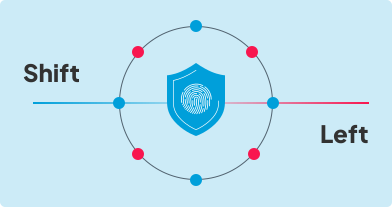
New business reality is that companies must prioritize cybersecurity compliance to protect customer data and demonstrate their security posture. The traditional reactive approach to compliance, treating it as a checklist for audits or regulatory deadlines, is no longer sufficient. Instead, forward-thinking organizations are adopting a shift-left strategy, embedding compliance into every stage of their workflows, starting at the design phase.
However, while this proactive approach offers substantial advantages, it also comes with challenges. Let's explore the benefits and hurdles of shift-left compliance, discuss how it meets modern customer expectations, and how to get there.
Benefits of Shift-Left Compliance
1. Early Risk Mitigation
By addressing compliance requirements early, businesses can identify and resolve potential vulnerabilities before they escalate, reducing the likelihood of breaches or fines.
2. Streamlined Processes
Integrating compliance into daily operations reduces the chaos of last-minute fixes during audits. Teams can focus on innovation and growth instead of scrambling to meet deadlines.
3. Improved Security Posture
Embedding compliance into workflows fosters a security-first culture, ensuring customer data remains protected at all times.
4. Cost Savings
Proactive compliance helps businesses avoid costly penalties, legal battles, and reputational damage.
5. Competitive Advantage
Organizations with continuous compliance demonstrate a commitment to security, building trust with customers and gaining a competitive edge in the marketplace.
Key Insight
Organizations that embed compliance into their development lifecycle from the start typically spend a fraction of what they would on late-stage remediation. The cost of fixing a control gap at the design stage is significantly lower than addressing it post-deployment, during an audit, or after an incident.
Challenges of Implementing Shift-Left Compliance
1. Lack of Expertise
Compliance frameworks like ISO 27001, SOC 2, and CMMC are complex and require specialized knowledge to implement correctly. Many organizations struggle to interpret these standards.
2. Cultural Resistance
Compliance-first thinking requires a cultural shift. Teams accustomed to viewing compliance as a late-stage task may resist integrating it into their processes.
3. Resource Constraints
Many businesses lack the budget or personnel to prioritize compliance from the outset, making it difficult to staff a dedicated security function early.
4. Complex Tooling
Integrating automated compliance tools into workflows can be technically challenging, leading to inefficiencies or incomplete reporting.
5. Balancing Innovation with Compliance
There's often a perception that compliance slows down innovation, creating tension between achieving business goals and adhering to security standards.
6. Evolving Regulations
Keeping up with continuously changing compliance requirements is a daunting task without dedicated resources.
Meeting Modern Customer Expectations
Today's customers demand more than just periodic audits or point-in-time certifications. They expect:
1. Continuous Assurance
Customers want to see evidence that their data is secure at all times, not just during annual reviews. Continuous compliance monitoring ensures your business is always audit-ready.
2. Real-Time Transparency
Customers value visibility into your compliance status. Providing real-time updates on your security practices reinforces trust and credibility.
3. Proactive Risk Management
Demonstrating that you actively mitigate risks reassures customers that you take their data security seriously. Identifying and addressing vulnerabilities early helps build confidence in your business.
Making Shift-Left Compliance Work in Practice
The shift-left approach works best when compliance becomes a natural byproduct of how the organization already operates, rather than a separate workstream. A few patterns make this practical:
Right-size the compliance program. Frameworks like NIST, ISO 27001, SOC 2, and CMMC all have different scoping requirements. The first step is mapping only the controls that apply to your environment and your risk profile, rather than treating every control as mandatory.
Automate evidence collection. Using an ISMS platform to automate the collection, organization, and storage of compliance evidence means audit readiness is maintained continuously. This removes the scramble before each audit cycle and ensures accuracy across the evidence base.
Monitor compliance posture in real time. Continuous monitoring identifies deviations or gaps the moment they arise, enabling prompt corrective action rather than discovering issues months later during an assessment.
Build transparency into the process. A public-facing trust center that reflects real-time compliance status builds customer confidence without requiring manual updates or one-off security questionnaire responses.
When these elements are in place, compliance shifts from a periodic project to an operational capability, and the evidence that auditors need is generated as a byproduct of daily operations.
Find Out Where Your Compliance Gaps Are
Our assessment identifies the fastest path from your current security posture to a fully effective security program.
Frequently Asked Questions
What does shift-left mean in cybersecurity compliance?
Shift-left means moving compliance activities earlier in your development and operational workflows rather than treating them as a late-stage checkpoint. Instead of scrambling to meet requirements before an audit, teams embed security controls and evidence collection into daily processes from the design phase onward. This approach catches gaps sooner and reduces the cost of remediation.
How does shift-left compliance reduce costs?
Addressing compliance requirements early prevents the expensive rework that comes from discovering gaps during audits or after incidents. Organizations that integrate compliance into their workflows avoid last-minute consulting engagements, emergency remediation projects, and potential regulatory penalties. The cost of fixing a control gap at the design stage is a fraction of what it costs post-deployment.
Which compliance frameworks benefit most from a shift-left approach?
Any evidence-based framework benefits, but ISO 27001, SOC 2, and CMMC see the largest gains because they require continuous control monitoring and regular evidence collection. Shift-left is especially effective for frameworks that demand ongoing proof of compliance rather than point-in-time snapshots, since the evidence is generated as a natural byproduct of operations.
How do you get engineering teams to adopt compliance-first thinking?
Start by integrating compliance checks into existing tools and workflows rather than adding separate processes. When security controls are part of CI/CD pipelines, code reviews, and infrastructure-as-code templates, engineers encounter compliance as a natural part of their work. Framing compliance as a quality attribute rather than a bureaucratic requirement also helps shift the cultural perception.
Ready to Start Your Compliance Journey?
Get a clear, actionable roadmap with our readiness assessment.
About the Author

Ali Aleali, CISSP, CCSP
Co-Founder & Principal Consultant, Truvo Cyber
Former security architect for Bank of Canada and Payments Canada. 20+ years building compliance programs for critical infrastructure.