SOC 2 for bare metal infrastructure

SOC 2 for Bare Metal & On-Premise Infrastructure

Effective security programs for SaaS companies on physical servers, colocation, and self-managed networks. Compliance is the byproduct.

Enterprise Deals Demand a SOC 2 Report

Your SaaS product runs reliably on physical infrastructure. Now a major customer wants your SOC 2 report, not the data center's. Every guide assumes cloud. None of it maps to bare metal, self-managed networks, and open-source security stacks.

That's exactly where we operate.


  • The On-Premise Evidence Gap

  • Cloud platforms automate 50-60% of SOC 2 evidence. On-premise starts at 20-30%. That's a design problem, and it's solvable.

icon-8

No Cloud APIs to Pull From

Compliance platforms are built for cloud. Physical servers with AD, self-hosted SIEM, and VPN don't have the same integrations. Evidence collection requires intentional design.

icon-7

Controls Map to Different Tools

Firewall appliance rules instead of security groups. AD GPOs instead of cloud IAM. Wazuh instead of GuardDuty. Same criteria, completely different implementations.

icon-9

Scoping Is More Complex

Shared network segments, physical access layers, hybrid workloads, and legacy systems all need careful scoping to avoid audit sprawl.

Our Three-Phase Methodology for On-Premise SOC 2

Effective security first. SOC 2 compliance follows. Designed for physical infrastructure, not adapted from a cloud playbook.

01

Assess

Full inventory of what's in the rack. Gap analysis against SOC 2 Trust Services Criteria. Evidence source mapping: what's automated vs. manual.

02

Build

Controls mapped to your actual stack. Two key deliverables: a Security Program Manual with policies and procedures tailored to your infrastructure, and a Security Posture Report giving leadership clear visibility. Every control purpose-built, not adapted from cloud templates.

03

Operate (Ongoing)

Ongoing program management with focus on on-premise evidence collection. Quarterly access reviews, vulnerability scanning, configuration monitoring, and continuous audit readiness. Security Posture Report updated regularly.

01 Assess

Goal: Establish the scope and find the gaps in your current security posture.

  • SOC 2 Gap Assessment

  • System & Data Scoping

  • System Description Development

  • Prioritized Remediation Roadmap

  • Technical Remediation Playbooks

MILESTONES
  • Gap Assessment Report

  • SOC 2 System Description

02 Build

Goal: Implement controls and automate processes for audit readiness.

  • GRC Platform Setup & Integration

  • Policy Customization 20+

  • Tailoring of Controls 100+

  • Customized Mapping of Tests to Controls

  • Fix Automated Evidence Collection Issues

  • Manual Evidence Collection

  • Company Risk Assessments

  • Vendor Risk Assessments

  • Security Awareness Training

  • Access Reviews

  • Penetration Testing

  • Internal Audit

  • Full External Audit Management

MILESTONES
  • Customized Policies 20+

  • Internal Audit Report

  • Penetration Test Report

  • SOC 2 Type I Attestation

03 Operate

Goal: Maintain and improve your compliance posture year-round.

  • Weekly Cadence Calls 

  • Active Compliance Program Management

  • Access to Security & Compliance SME

  • Security Architecture Advisory

  • Continuous Control Monitoring

  • Continuous Evidence Collection

  • Ongoing Company Risk Assessments

  • Ongoing Vendor Risk Assessments

  • Security Awareness & Training

  • Quarterly Access Reviews

  • Annual Policy Updates & Acknowledgement

  • Annual Internal Audit

  • Annual Penetration Testing

  • Annual External Audit Management

MILESTONES
  • Updated Policies 20+

  • Penetration Test Report

  • Internal Audit Report

  • SOC 2 Type II Attestation

Warning: Not All SOC 2 Consultants Understand On-Premise.

Cloud-only consultants force cloud patterns onto physical infrastructure, creating controls that don't match and documentation auditors see through.

Why Our Effective Security Approach Works for Bare Metal

A certificate that doesn't reflect your actual posture fails the first time a sophisticated buyer asks questions.

The All-in-One Solution for On-Premise SOC 2

Annual fixed-price package: Build + Operate. Security Program Manual, Security Posture Report, and continuous compliance management for on-premise infrastructure.

  • Everything in Build

  • Everything in Operate

  • GRC Platform License

  • Annual Penetration Test

  • External Audit

  • Internal Audit

Trusted by Companies Running Physical Infrastructure

They don’t just provide recommendations; they ensure we meet our stringent ISO 27001 and SWIFT compliance goals. We trust them with projects of national importance, and they deliver.

Matt Charette

CISO at Payments Canada

SOC 2 for Bare Metal: Frequently Asked Questions

Yes. SOC 2 Trust Services Criteria describe outcomes, not specific technologies. They don't require cloud infrastructure. Firewall appliances, Active Directory, self-hosted SIEM, and physical access controls all satisfy the same criteria that cloud-native tools do. The difference is in how you collect and present the evidence.

The main difference is evidence automation. Cloud compliance platforms pull 50-60% of evidence automatically through API integrations. On-premise environments start at 20-30% automated coverage. The controls themselves are equivalent, but you need a deliberate evidence collection architecture built around your existing tools: syslog exports, AD audit logs, SIEM queries, and scheduled vulnerability scans.

A GRC platform is still valuable for on-premise environments, but it covers less ground automatically. Platforms like Vanta, Drata, and Secureframe can manage policies, track controls, and automate evidence for cloud services and SaaS tools you use. For the physical infrastructure layer, we design supplemental evidence collection workflows that feed into the platform.

The Security Program Manual is the internal-facing operational playbook that defines how every security domain is run, by whom, to what standard, and on what cadence. For each domain, the manual defines the scope (which systems and data assets the domain applies to), the tools in use, the evidence being captured and how it's retained, the operating process and cadence, and the people who own it.

The Security Posture Report is the external-facing counterpart to the Security Program Manual — a shareable, unaudited package that includes a documented security program, architecture and data flow diagrams, and a buyer-ready summary. It explains the foundations of your security program to customers, prospects, and partners so you can start answering security questions with confidence before the audit is even complete. Most companies have deals in motion that can't wait months for a full audit.

Typically 3-6 months from assessment to Type 1 audit. The Assess phase takes 2-4 weeks, the Build phase 4-8 weeks depending on the gap size, and audit preparation 2-4 weeks. On-premise environments sometimes require more time in the Build phase due to evidence collection architecture design, but companies with mature security practices often have fewer gaps than they expect.

Ready to Build an Effective Security Program?

Free assessment for your on-premise infrastructure against SOC 2 requirements.

Group 39868

From the Blog: SOC 2 for On-Premise Infrastructure

Our series on building effective security programs for bare metal and hybrid environments.

SOC 2 Vulnerability Scanning for On-Prem: Tiered Scanning Without Cloud-Native Tools

Every SOC 2 vulnerability scanning guide assumes the same starting point: connect a cloud-native scanner, enable automated assessments, and let the ...
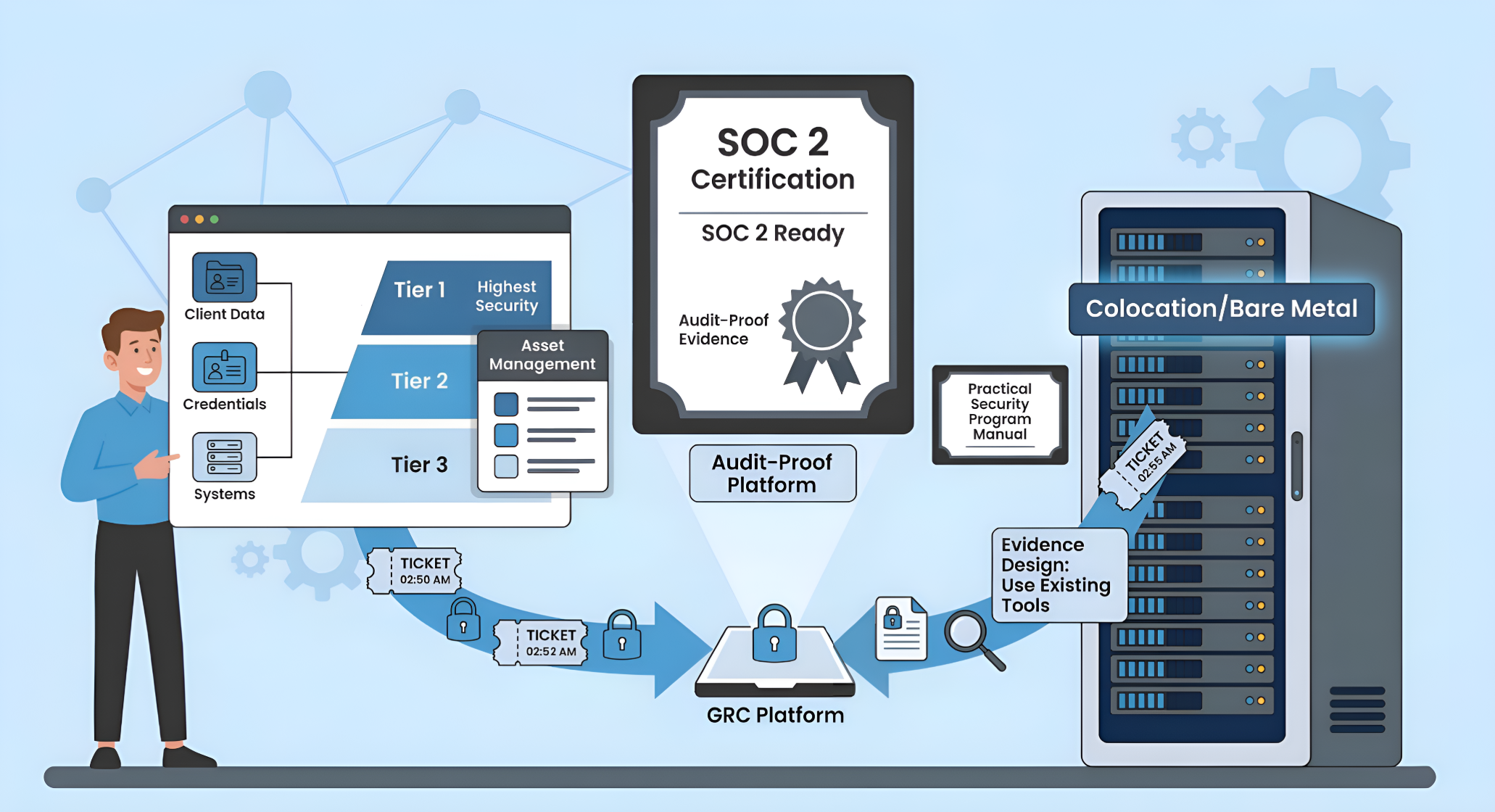
SOC 2 Readiness for Bare Metal SaaS: What to Expect When You Don't Run on AWS

A pattern keeps showing up. A SaaS company that has been running successfully for years, sometimes a decade or more, gets a call from a major ...
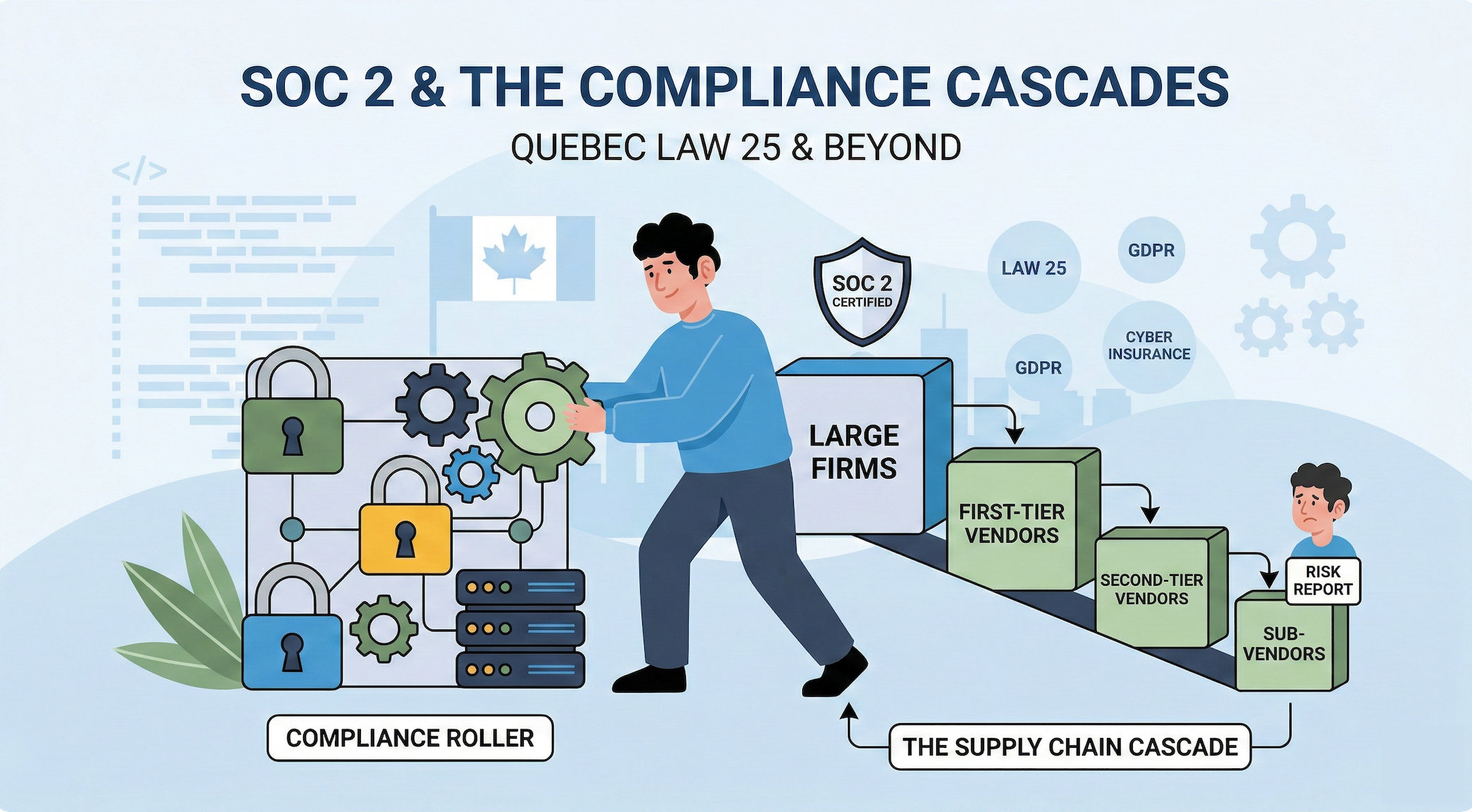
The SOC 2 Snowball: How Law 25 Is Pushing Compliance Down the Supply Chain

SOC 2, and compliance in general, is self-perpetuating. Once a company achieves certification, one of the first things the framework requires is ...