.svg)

TL;DR: For SOC 2 compliance, under the Trust Services Criteria, you need a formal, trackable process for all security-relevant activities. This means using a ticketing system with clearly defined Service Level Agreements (SLAs) for vulnerability patching (CC7.1), security incidents, and other critical tasks. Auditors will verify your adherence to these SLAs. Implement severity-based SLA tiers (e.g., Critical: 24-48 hours, Medium: 14 days). GRC platforms like Secureframe, Vanta, or Drata can automate evidence collection, connect to your ticketing system, and monitor SLA compliance, significantly simplifying your audit process and strengthening your security posture.
Operationalizing SOC 2: Formal Tracking and SLAs
Achieving and maintaining SOC 2 compliance for your small SaaS company isn't just about implementing controls; it's about proving they work consistently. The final, crucial phase of operationalizing many of your SOC 2 controls involves how you respond to security events—whether they are system vulnerabilities, security incidents, or necessary system changes. This capability is primarily achieved through a formal, trackable process, usually managed via a ticketing system.
For auditors, comprehensive evidence is non-negotiable. They require proof that all security-relevant activities are formally tracked, assigned, and resolved. The SOC 2 Trust Services Criteria, particularly criteria like CC7.1 (Vulnerability Management), demand that issues are addressed in a timely manner as defined by your documented Service Level Agreements (SLAs). Without a clear, auditable trail, proving your controls are effective becomes a significant hurdle.
The Non-Negotiable: Formal Tracking for SOC 2 Compliance
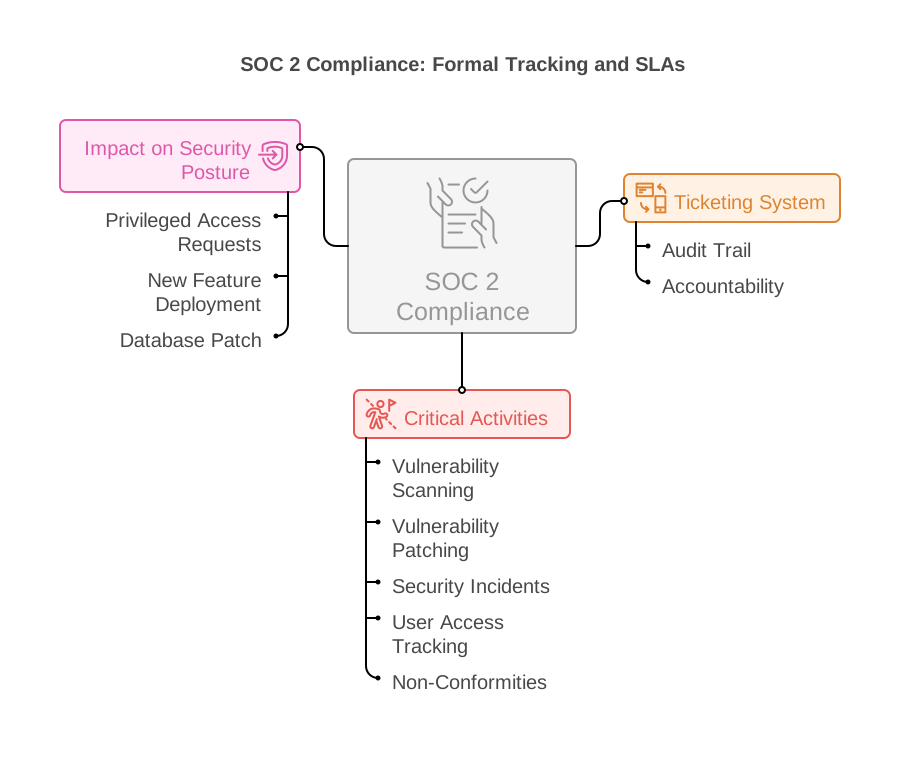
A robust ticketing system isn't just a project management tool; it's your primary mechanism for demonstrating accountability and control effectiveness to a SOC 2 auditor. It provides the necessary audit trail, recording key details like the date an issue was identified, its assigned severity, who was responsible for fixing it, the time taken for resolution, and the final resolution steps.
While tracking any system change is a good practice, certain activities are critical for SOC 2 purposes and demand formal tracking with associated SLAs:
- Vulnerability Scanning: Documenting the performance of scheduled and ad-hoc vulnerability scans.
- Vulnerability Patching: Tracking the remediation of identified vulnerabilities, directly supporting CC7.1
- Security Incidents: Managing the detection and response to confirmed breaches or malicious activity, which ties into the Availability and Confidentiality criteria.
- User Access Tracking: Maintaining auditable records of all user access requests, including granting, modification, and removal, crucial for the Security criteria.
- Non-Conformities/Compliance Corrections: Tracking tasks to correct internal control deficiencies identified during self-assessment or audit, demonstrating continuous improvement.
For your SaaS, consider how a customer's access request, a new feature deployment, or a database patch directly impacts your security posture and, by extension, your SOC 2 readiness. Each of these should ideally flow through a formal tracking mechanism.
Defining and Enforcing Service Level Agreements (SLAs)
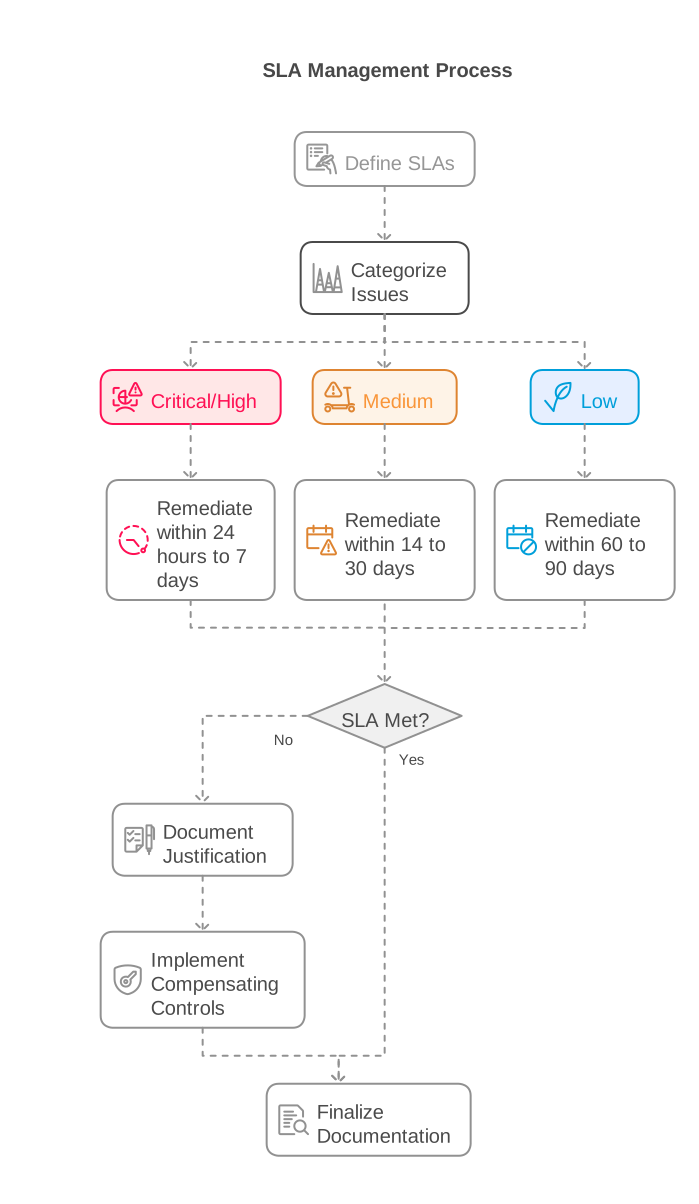
The concept of "timely" remediation or response, a cornerstone of SOC 2, is explicitly defined by your organization's formally documented SLAs. An auditor will test a sample of tickets to ensure the resolution time met your stated SLA. These SLAs must be formally documented in your policies, such as your Incident Response Policy or Vulnerability Management Policy.
SLAs should be applied based on the severity of the issue, reflecting its potential impact on your system's security, confidentiality, availability, or processing integrity. A common tiered approach includes:
- Critical/High: Must be addressed and remediated within the shortest timeframes (e.g., 24 hours to 7 days). This tier typically applies to critical vulnerabilities (e.g., a zero-day exploit) or confirmed security incidents (e.g., unauthorized data exfiltration).
- Medium: Given more time for remediation (e.g., 14 to 30 days). This could include a vulnerability requiring a patch that isn't publicly exposed or a non-critical system misconfiguration.
- Low: Given the most time, as the risk is minimal (e.g., 60 to 90 days). Examples might be minor security hardening recommendations or informational findings from a scan.
What happens if an SLA is missed? You must document the justification (e.g., "required a third-party patch that was delayed," "deprioritized due to a critical incident") and any compensating controls implemented during the delay. This demonstrates that you are aware of the miss and have taken steps to mitigate the risk, which is vital for an auditor.
Practical Application: Vulnerability Patching SLAs (CC7.1)
Vulnerability patching is a high-focus area for SOC 2 auditors, particularly for any publicly exposed systems or customer-facing applications. Under Trust Services Criteria CC7.1, you must have controls in place to manage vulnerabilities and implement corrective actions.
Vulnerability tickets can originate from various sources: automated SAST/DAST scans during your CI/CD pipeline, daily threat intelligence monitoring, or penetration testing results. Regardless of the source, your organization must have an explicit policy stating the SLA for patching vulnerabilities based on their severity, often defined by systems like CVSS scoring.
Example: Your SaaS company, 'CloudFlow,' uses a publicly accessible API. A recent penetration test identified a critical SQL injection vulnerability. Per your Vulnerability Management Policy, critical vulnerabilities must be remediated within 48 hours. Your team creates a ticket, assigns it to the development lead, and tracks its progress. The auditor will later review this ticket to confirm it was resolved within the 48-hour window, providing direct evidence of your adherence to CC7.1.
Practical Application: Incident Response SLAs
Should a security incident occur, your organization's response time is paramount, directly impacting the Availability and Confidentiality criteria of SOC 2. Your policies must clearly define what constitutes a security incident versus a standard operational issue to ensure appropriate escalation and response.
An SLA must be set not just for resolution, but also for detection, triage, and initial response to a confirmed incident. This demonstrates your organization’s ability to limit the damage and duration of a security event. Rapid response can minimize data loss, system downtime, and reputational harm.
Example: 'SecureVault,' your SaaS platform, detects unusual activity on a customer database, flagging a potential unauthorized access attempt. Your Incident Response Policy dictates that all potential incidents must be triaged within 1 hour and a confirmed incident must have an initial containment strategy in place within 4 hours. The security team creates an incident ticket, triggering alerts and assigning it to the incident response lead. The auditor will examine the incident ticket's timeline, confirming that your team met the defined SLAs for detection, triage, and initial response.
Streamlining with GRC Platforms and Ticketing Systems
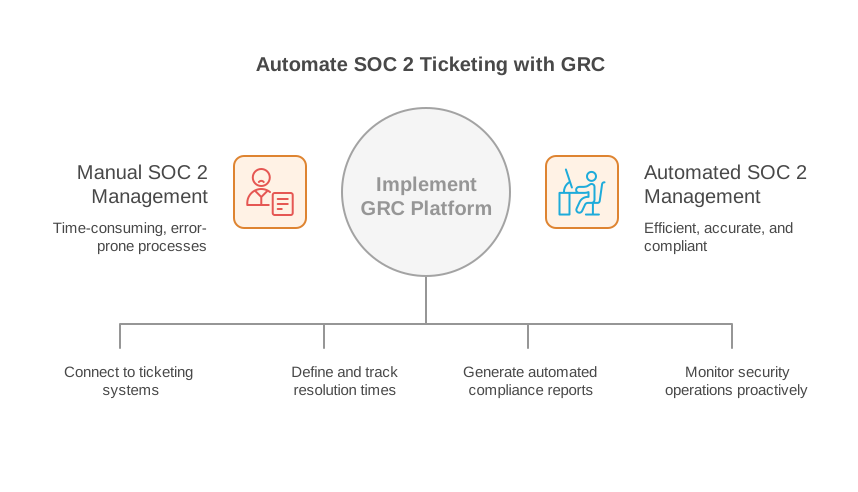
While you can certainly use a standalone ticketing system like Jira, ServiceNow, or Linear, integrating it with a Governance, Risk, and Compliance (GRC) platform significantly simplifies evidence collection and ongoing compliance for SOC 2. Without integration, an auditor would manually request a comprehensive list of all security-related tickets, their associated SLAs, and their resolution times, creating a labor-intensive, back-and-forth process.
The GRC advantage comes from platforms such as Secureframe, Vanta, Drata, or Scrut. These platforms connect directly to your task management systems and automatically apply SOC 2 principles to your tickets. Here's how they help:
GRC Platform Benefits for SOC 2 Ticketing & SLAs
GRC platforms offer robust features designed to automate and simplify your SOC 2 ticketing and SLA management:
- Integration & Filtering: GRC platforms connect seamlessly to popular ticketing systems. They use specific labels (e.g.,
SOC2-VULN,SECURITY-INCIDENT) to automatically pull only relevant security tickets into your compliance workspace, eliminating manual data sifting. - SLA Monitoring: You can define and configure your severity-based SLAs directly within the GRC platform. The platform then automatically monitors the actual resolution time against your target SLA for every ticket, providing real-time compliance status.
- Evidence Provisioning: When audit time comes, the GRC platform automatically generates comprehensive SLA compliance reports for the auditor. These reports show a clear, pre-filtered sample of high-severity items and precisely prove your organization's adherence to its documented policies, saving countless hours.
- Continuous Compliance: Beyond audit readiness, GRC platforms enable continuous monitoring of your security operations, alerting you to missed SLAs or emerging compliance gaps before they become major issues.
Conclusion: Proactive Security Governance
Effective ticketing and SLA management are not just compliance checkboxes; they are fundamental to your small SaaS company's security posture and operational resilience. By formalizing your tracking processes, defining clear severity-based SLAs, and leveraging GRC platforms, you transform a potentially overwhelming manual compliance burden into a system of proactive, measurable security governance. This approach not only ensures you meet SOC 2 requirements for criteria like CC7.1 but also builds a stronger, more secure foundation for your business, giving your customers confidence in your commitment to their data security.