.svg)
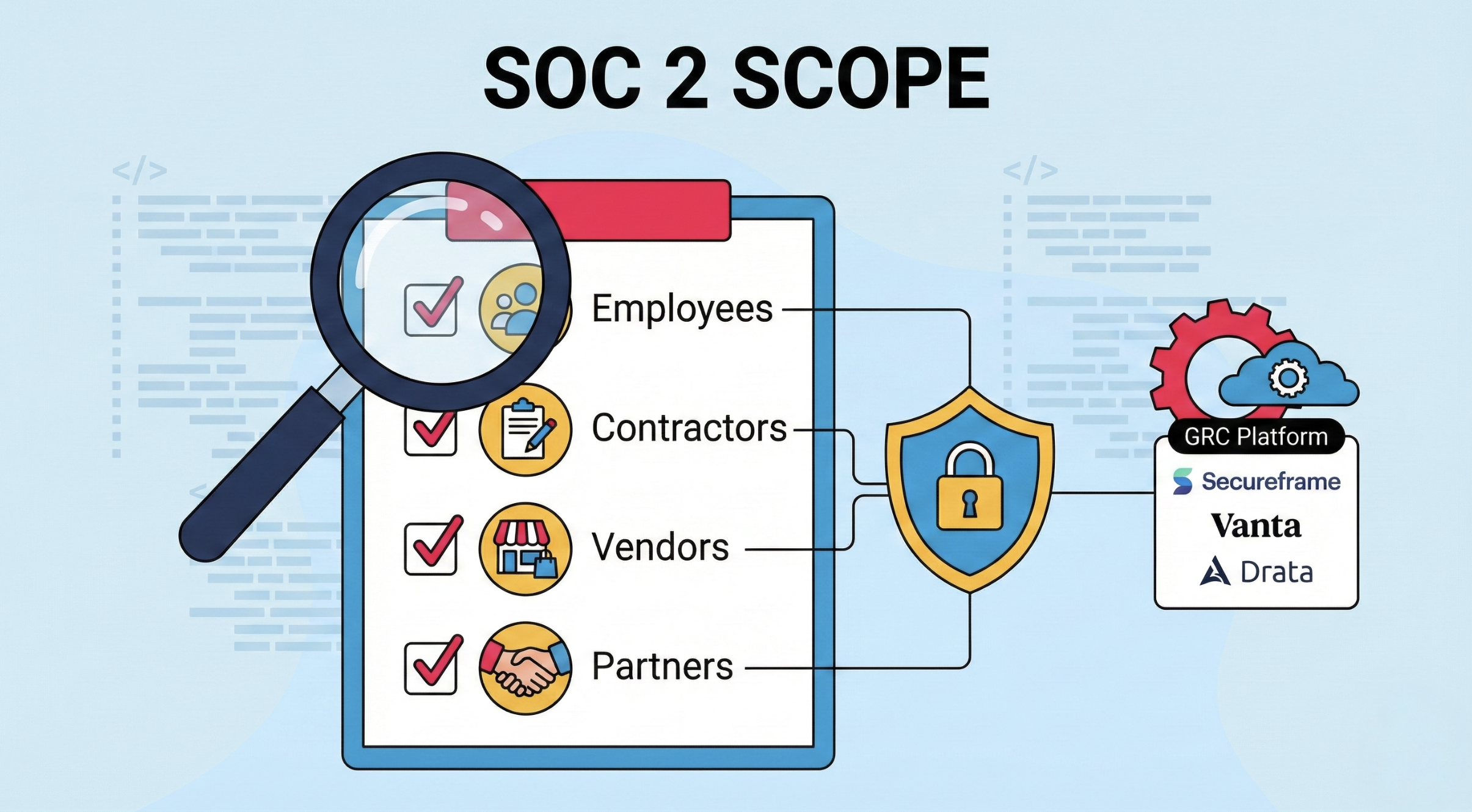
TL;DR: Defining your SOC 2 scope means identifying every individual and entity whose activities impact your system's ability to meet its Trust Services Criteria (TSC) commitments. This includes not just your direct employees, but also contractors, vendors, and business partners. The core question is: Does their role or access directly or indirectly affect your system’s service commitments to customers? Personnel with direct system access (developers, IT ops) and all personnel for security awareness (aligned with TSC CC1.1) are always in-scope. Customer support, HR, and finance might be in-scope if they handle sensitive data or impact access controls. For outsourced relationships, ensure policy acknowledgment (CC1.1, CC1.4, CC8.1) to extend your control environment. GRC platforms like Secureframe, Vanta, or Drata are essential tools for streamlining this complex process.
Understanding SOC 2 Scope: Who's Really In?
As a CTO of a small SaaS company, you already grasp the critical importance of a SOC 2 report. It's your commitment to security, availability, processing integrity, confidentiality, and privacy—the Trust Services Criteria (TSC)—that builds customer trust and opens new market opportunities. But when it comes to the actual audit, a common question arises: who exactly needs to be included in the scope?
A SOC 2 examination isn't just about your technology; it's fundamentally about the system that provides services to your customers. The AICPA defines a system as infrastructure, software, procedures, and data that are designed, implemented, and operated by people to achieve specific business objectives. Therefore, the scope extends to all personnel whose activities directly or indirectly impact the controls designed to meet those applicable Trust Services Criteria. This definition goes beyond your W-2 employees, encompassing contractors, vendors, and even business partners. Understanding this boundary is key to avoiding audit surprises and ensuring your controls are effective.
Core Criteria: Does Their Role Impact Your Trust Service Criteria?
The litmus test for inclusion in your SOC 2 scope is straightforward: does an individual's role and access directly or indirectly affect your system's ability to meet its service commitments to your customers? If the answer is yes, they are likely in-scope. This principle underpins the entire scoping exercise, guiding you in identifying the critical human elements of your control environment.
Direct System Access: The Obvious In-Scope
Any individual with logical or physical access to protected information assets or sensitive systems that support your services must be in-scope. This category is often the most apparent:
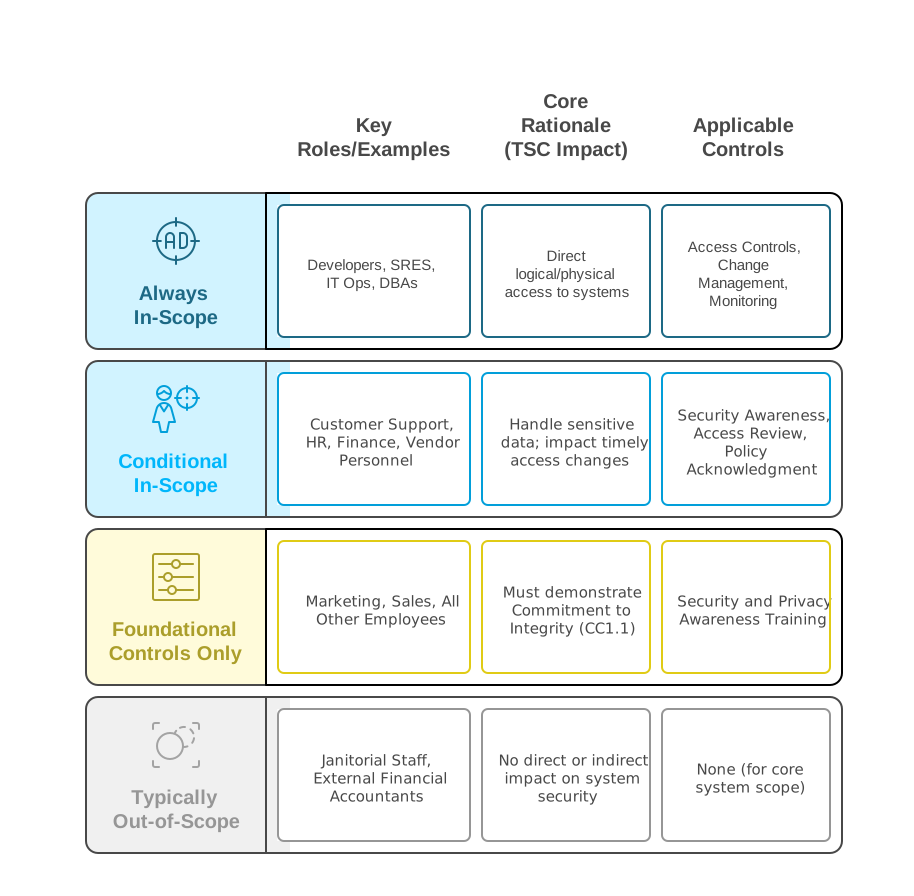
- Production System Access: Your software developers, site reliability engineers, and DevOps personnel who directly access or deploy changes to your production environment are always in-scope. For example, a developer at 'Innovate SaaS' pushing code updates directly impacts the security and availability of your service.
- System Development and Maintenance: Engineers, quality assurance (QA) personnel, and architects who access development, staging, or testing environments where changes are made to the system fall into this category. Their activities, while not directly in production, prepare the changes that will eventually impact production.
- System Operations: IT operations staff, database administrators (DBAs), and network engineers who manage your infrastructure, databases, and network configurations are also critical. A DBA at 'DataFlow Solutions' managing the central customer database directly influences processing integrity and confidentiality.
Impacting the Control Environment: Everyone's Role in Security
Beyond direct system access, a broader group of personnel impacts your overall control environment. The Trust Services Criteria emphasize a 'Commitment to Integrity and Ethical Values' (CC1.1) and ensuring 'Competent Individuals' (CC1.4). This means:
- Security and Privacy Awareness Training: All employees, including non-IT personnel, must be in-scope for security and privacy awareness training. This demonstrates your organization's commitment to ethical values and ensures a baseline understanding of security protocols across the board. For instance, every employee at 'CloudConnect Inc.' needs to understand phishing risks, even if they don't touch production systems.
- Management and Oversight: Your senior management team and board of directors (if applicable) are in-scope due to their oversight activities. Their role in establishing and maintaining the internal control system is fundamental. They set the tone at the top, which is a core component of the control environment.
Beyond Your Payroll: Contractors, Vendors, and Business Partners
Your SOC 2 report isn't confined to your direct employees. The modern SaaS ecosystem relies heavily on third-party services, and your SOC 2 scope must reflect this reality. When you outsource tasks or entire functions, you introduce additional risks that need to be addressed within your control environment. The AICPA's SOC 2 guidance explicitly defines 'business partners' as individuals or businesses involved with your entity's dealings or cooperating with you, which can include vendors or subservice organizations.
For these external entities, you have two primary methods for addressing them in your SOC 2 report: the 'inclusive' method (where their controls are part of your system description) or the more common 'carve-out' method (where their services are identified, but their controls are excluded, with your controls over monitoring them included). Regardless of the method, understanding when their personnel are in-scope is crucial.
.svg)
The 'May Be In-Scope' Grey Area: Direct Support Functions
Some roles may not have direct technical system access but still perform functions critical to your service delivery or impact your control environment. These warrant careful consideration:
- Customer Support: If your customer support team handles sensitive customer data (e.g., payment details, personal information), performs functions that compensate for automated system controls, or authorizes service activity workflows, their personnel are typically in-scope. Consider 'HelpDesk Hero's' support team, who access customer accounts to troubleshoot issues and might reset passwords, directly impacting customer data confidentiality and system security.
- Human Resources/Finance: These departments are generally in-scope if their actions directly impact system controls. For example, an HR manager processing a termination must trigger the timely removal of system access for that employee, a control critical to security (CC6.1). If your finance team handles billing data within the system boundaries, they would also be in-scope for relevant controls.
Conversely, some roles are typically out of scope for the core system boundaries:
- Non-Relevant Support: Janitorial or office maintenance staff. Their services do not directly impact the security, availability, or integrity of your information systems.
- External Accountants: If they only handle your company's financial records and have no access to the customer-facing system or its underlying data.
- Marketing Manager: If their access is limited to non-production systems (e.g., website analytics, public email lists) that do not store or process customer data related to the contracted service. Note that they would still be in-scope for foundational controls like security awareness training, as are all employees.
Policy Acknowledgment: Extending Your Control Environment
When you engage outsourced service providers or business partners, your responsibility for maintaining a robust control environment doesn't end at your company's walls. The Trust Services Criteria specifically address this through the Control Environment component:
- Commitment to Integrity and Ethical Values (CC1.1): Your management must establish clear expectations of integrity and ethical values, defined in your standards of conduct. Crucially, these must be understood by outsourced service providers and business partners.
- Competent Individuals (CC1.4): You need to assess the skills and technical competency of potential and existing personnel, including contractors and vendor employees, to ensure they can fulfill their roles effectively and securely.
The acknowledgment process is how you demonstrate that outsourced personnel have received and understood the necessary standards to protect your customers' data and systems. This is more than just a checkbox; it's evidence that your control environment extends to anyone interacting with your system.
To effectively manage these relationships, you must have policies and practices that:
- Establish Standards of Conduct: Clearly define your expectations for ethical behavior, security practices, and incident reporting.
- Evaluate Adherence: Implement processes to periodically review the performance of these third parties against your standards. This might involve reviewing their own SOC 2 reports or conducting vendor security assessments.
- Address Deviations: Have clear procedures for identifying and remedying any deviations from your expected standards in a timely and consistent manner.
The policies requiring acknowledgment minimally include your Standards of Conduct, your overarching Security Policy (especially regarding access, acceptable use, and incident reporting), and if they perform development or maintenance work, your Change Management Policies (relevant to CC8.1 – Changes to the system are authorized, designed, developed, configured, documented, tested, approved, and implemented to meet the entity’s objectives). By obtaining these acknowledgments, you are building a documented chain of evidence that your control environment is comprehensive.
Streamlining Scope Management with GRC Platforms
Manually tracking every individual, their access, their training status, and policy acknowledgments across your employees, contractors, and vendors can quickly become an administrative burden. This is where modern Governance, Risk, and Compliance (GRC) engineering platforms prove invaluable for a busy CTO.
Platforms like Secureframe, Vanta, and Drata are designed to automate and centralize many aspects of SOC 2 compliance, including scope management. They can integrate with your HRIS, identity providers (IdP), and other systems to automatically identify personnel, track their onboarding/offboarding status, monitor access permissions, and manage security awareness training completion and policy acknowledgments. For example, 'NexusTech SaaS' used a GRC platform to automatically flag when a contractor hadn't completed their annual security training, ensuring continuous compliance without manual oversight.
These platforms help you maintain an up-to-date roster of in-scope personnel, collect necessary evidence, and provide a single source of truth for your auditors. This not only saves significant time and resources but also provides real-time visibility into your compliance posture, allowing you to proactively address gaps rather than react to audit findings.
Your Action Plan: Defining and Managing Your SOC 2 Scope
Defining and maintaining your SOC 2 scope is an ongoing process, not a one-time event. As your SaaS company grows, new roles emerge, and vendor relationships evolve, your scope will need to be reviewed and adjusted. Here’s your actionable plan:
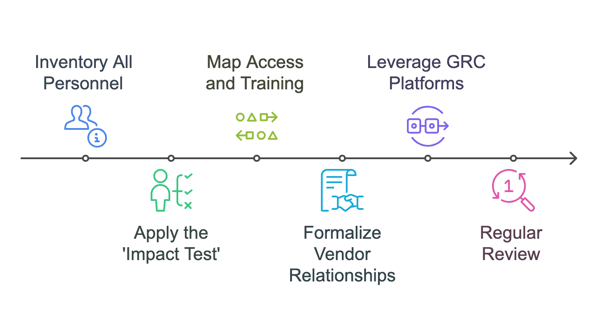
- Inventory All Personnel: Create a comprehensive list of all individuals (employees, contractors, vendors, business partners) who interact with your systems or impact your control environment.
- Apply the 'Impact Test': For each individual, ask: Does their role or access directly or indirectly affect your ability to meet your SOC 2 Trust Services Criteria? Document your rationale.
- Map Access and Training: Ensure all personnel with system access have appropriate controls in place (e.g., MFA, least privilege). Confirm all in-scope personnel receive mandatory security awareness training (CC1.1).
- Formalize Vendor Relationships: For outsourced providers, establish clear contracts, define standards of conduct, and obtain policy acknowledgments (CC1.1, CC1.4, CC8.1). Request and review their SOC 2 reports if applicable.
- Leverage GRC Platforms: Implement a GRC solution to automate personnel tracking, access reviews, training management, and policy acknowledgment collection. This will drastically reduce manual effort and improve audit readiness.
- Regular Review: Periodically review your scope (at least annually, or when significant organizational changes occur) to ensure it remains accurate and comprehensive.
By proactively managing your SOC 2 scope, you're not just preparing for an audit; you're strengthening your overall security posture, reinforcing customer trust, and ensuring your SaaS company operates with integrity and resilience. This strategic approach to compliance is a competitive advantage, not just a regulatory burden.
.png?width=155&height=82&name=Arrow%205%20(1).png)